

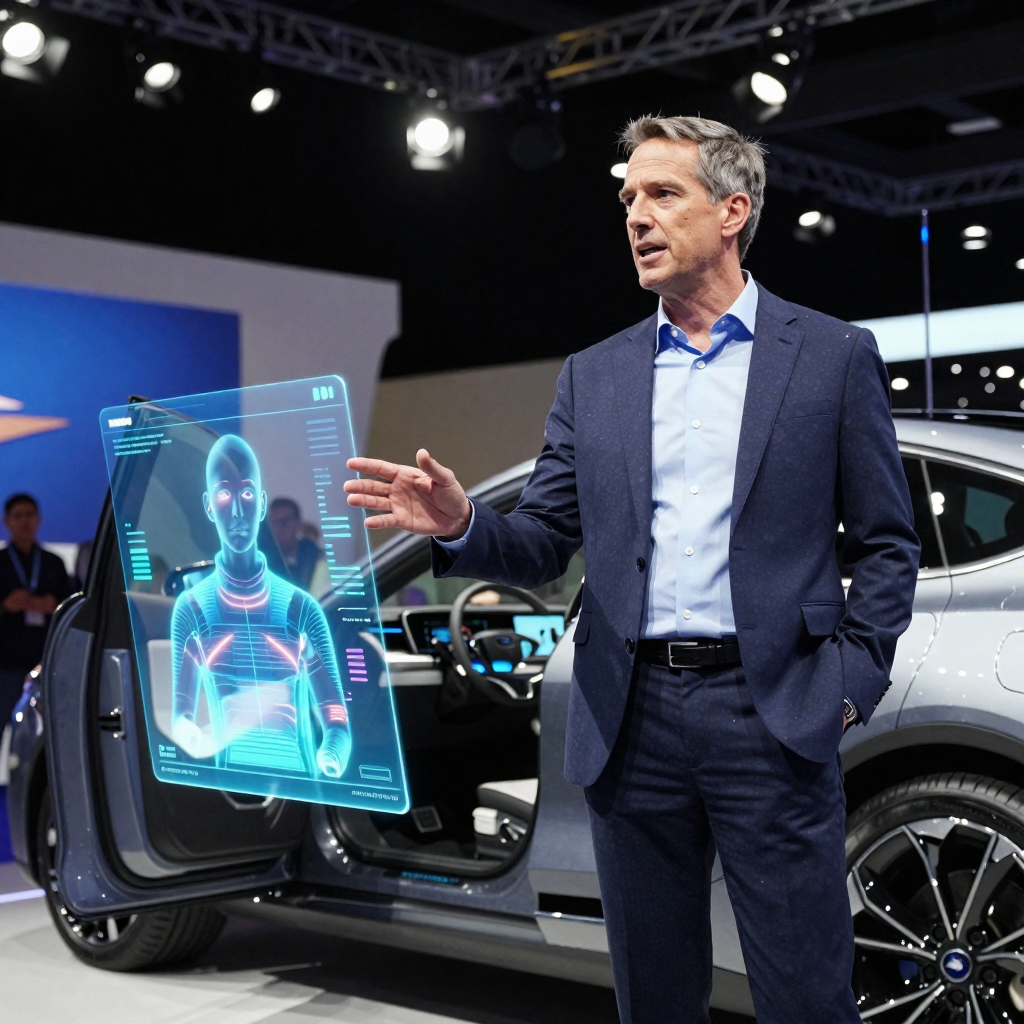
CES 2026: Ford Unveils AI Assistant That Turns Your Car Into a Personal Digital Co‑pilot
The buzz at CES 2026 is impossible to miss. Ford has just launched its groundbreaking AI Assistant, and it feels like stepping into the future of driving. Imagine a voice that not only obeys commands but also learns your habits, suggests routes, and even manages your calendar while you cruise. This personal digital co‑pilot is designed to make every journey smoother, safer, and more enjoyable. At the showcase, engineers demonstrated how the assistant can answer questions, control in‑car settings, and even predict traffic before you hit the road. Because of this innovation, drivers can focus more on the road and less on fiddling with screens. Moreover, the AI learns from each trip, tailoring recommendations to your preferences over time. As the event progressed, visitors reported a sense of confidence they had never felt in a vehicle before. Ford’s AI Assistant is more than a feature; it’s a step toward truly intelligent transportation. Stay tuned as CES 2026 continues to reveal how this technology will roll out to consumers later this year, reshaping the way we interact with our cars. The system also integrates seamlessly with Ford’s existing infotainment platforms, providing real‑time updates on weather, fuel efficiency, and even nearby charging stations for electric models. Early adopters say this level of connectivity could redefine daily commutes and long‑haul trips alike.
What is Ford’s AI Assistant and Why It Matters at CES 2026
Ford’s AI Assistant is a conversational, context‑aware system built into the generation of Ford vehicles. Unveiled at CES 2026, it works as a digital co‑pilot, letting drivers interact with the car using language while staying focused on the road.
Powered by a blend of language models and Ford’s proprietary data streams, the assistant can understand driver intent, predict needs, and execute commands across infotainment, navigation, climate, and vehicle diagnostics. Its design emphasizes safety, convenience, and a human‑like relationship between people and their automobiles.
Key features include:
- Voice‑first interaction that works hands‑free and adapts to regional accents.
- Real‑time route optimization that considers traffic, weather, and driver preferences.
- In‑car climate control that auto‑adjusts temperature based on occupancy and external conditions.
- Predictive maintenance alerts that schedule service before issues arise.
- Personalized media recommendations powered by the Ford AI Assistant’s learning engine.
- Seamless integration with smartphones and smart home devices for an experience.
Because the assistant learns from each journey, it tailors suggestions such as preferred music playlists, coffee‑shop stops, or charging station recommendations for electric models. Drivers report a smoother, more enjoyable ride, while the system continuously improves its accuracy through on‑device learning. In short, Ford’s AI Assistant turns a vehicle into an intelligent companion that enhances safety, efficiency, and driver satisfaction.
Looking ahead, Ford plans to expand the assistant’s capabilities through OTA updates, adding language support, and assistance functions that will further blur the line between vehicle and digital assistant.
Comparison of In‑Car AI Assistants
| Brand | Launch Year | Key Capabilities | CES 2026 Highlights |
|---|---|---|---|
| Ford | 2023 | Voice‑controlled navigation, adaptive climate, predictive maintenance, seamless smartphone integration | Showcased new large‑language‑model assistant with real‑time contextual replies and over‑the‑air updates |
| Tesla | 2015 (Autopilot) | Advanced driver assistance, lane‑keeping, auto‑lane change, voice commands for climate and media | Demonstrated “Tesla Bot” integration for in‑car concierge features and improved natural‑language understanding |
| BMW | 2018 | Personal assistant with gesture control, navigation, vehicle settings, and integration with BMW ConnectedDrive | Unveiled BMW iX “AI Co‑Pilot” featuring multimodal interaction and enhanced AR heads‑up display |
| Hyundai | 2020 | Voice assistant for navigation, infotainment, vehicle diagnostics, and smart home connectivity | Presented upgraded “Hyundai SmartSense” with generative AI for proactive trip planning and multilingual support |
How Ford’s AI Assistant Enhances Driver Experience at CES 2026
The live demo at CES 2026 showed the AI co‑pilot turning ordinary trips into safer, smoother journeys. When the system detected a sudden lane drift, it instantly issued a calm voice alert and gently corrected steering, proving that predictive safety can act before a driver even realizes a risk. In the showroom, attendees praised how the assistant seamlessly handled navigation, climate control, and media without requiring eyes off the road, highlighting a genuine boost to driver safety.
Beyond protection, convenience surged. The assistant learned the driver’s daily routine during the demo and automatically scheduled charging stops, pre‑heated the cabin, and suggested optimal routes based on real‑time traffic. This hands‑free orchestration reduced the cognitive load that typically distracts drivers, allowing them to focus on the road ahead.
Personalization also reached a new level. By analyzing voice tone and facial cues, the AI adjusted music playlists, ambient lighting, and even suggested nearby coffee shops that matched the driver’s mood. Testers at CES 2026 reported feeling that the car “understood” them, turning each drive into a tailored experience.
Three major benefits revealed at CES 2026
- Proactive safety interventions – real‑time hazard detection and automatic corrective actions keep occupants out of danger.
- Streamlined convenience – autonomous scheduling of charging, climate, and navigation eliminates routine distractions.
- Deep personalization – adaptive infotainment and environment settings create a driver‑centred cabin that responds to mood and preference.
This breakthrough promises safer, smarter journeys for all drivers everywhere.
Conclusion
Ford’s AI Assistant, unveiled at CES 2026, marks a pivotal step toward truly intelligent vehicles. By blending voice‑first interaction, real‑time data integration, and predictive assistance, the system transforms the cabin into a personal digital co‑pilot that anticipates needs, reduces distractions, and enhances safety. Drivers now enjoy seamless navigation, proactive maintenance alerts, and personalized entertainment—all delivered through a conversational interface that feels natural and intuitive.
The benefits extend beyond convenience. With contextual awareness, the assistant can suggest optimal routes based on traffic, weather, and driver preferences, while simultaneously monitoring vehicle health to prevent breakdowns. This proactive approach not only saves time but also contributes to lower emissions and reduced operating costs. Moreover, the integration of over‑the‑air updates ensures the assistant evolves with emerging services, keeping owners at the forefront of automotive innovation.
Behind this breakthrough is SSL Labs, an innovative Hong Kong‑based AI startup dedicated to democratizing artificial intelligence. Our mission is to empower businesses and individuals with secure, scalable AI solutions that solve real‑world problems. We specialize in AI application development, end‑to‑end machine‑learning pipelines, advanced natural‑language processing, computer‑vision tools, and predictive analytics. Ethical AI is at the core of our philosophy—we prioritize transparency, bias mitigation, and privacy‑by‑design in every product. All solutions are built on robust security frameworks, ensuring data integrity and compliance across cloud and edge environments.
Stay tuned to SSL Labs for the next wave of AI advancements. Follow us on our website, GitHub, and social channels to discover how we continue to shape the future of intelligent technology.
Frequently Asked Questions (FAQs)
Q1: What is Ford’s AI Assistant?
A: Ford’s AI Assistant is an integrated, voice‑activated digital co‑pilot that helps drivers control navigation, climate, entertainment, and vehicle diagnostics using natural language, enhancing safety, convenience, and providing personalized recommendations through continuous learning for each journey.
Q2: How does the AI Assistant work in Ford vehicles?
A: It combines on‑board processing with cloud‑based machine learning, interpreting spoken commands, learning driver preferences, delivering contextual suggestions, and optimizing energy usage, all while maintaining data privacy and low latency in real‑time for smoother operation.
Q3: When will the AI Assistant be available to consumers?
A: The assistant launched globally in early 2026, rolling out first to 2024‑2025 model years and expanding to older models via over‑the‑air updates, supporting new OTA features throughout the year and improving performance for users.
Q4: Why is CES 2026 important for Ford’s AI Assistant?
A: CES 2026 showcased the assistant’s live demos, highlighting real‑time language translation, predictive maintenance alerts, seamless integration with smart home devices, and advanced AI‑driven insights, positioning Ford as a leader in automotive AI globally.
Q5: Can the AI Assistant be customized?
A: Yes, drivers can personalize voice profiles, set preferred commands, choose from multiple assistant personalities, and ensure seamless updates, allowing a tailored experience that adapts to individual habits and regional accents across all devices.