

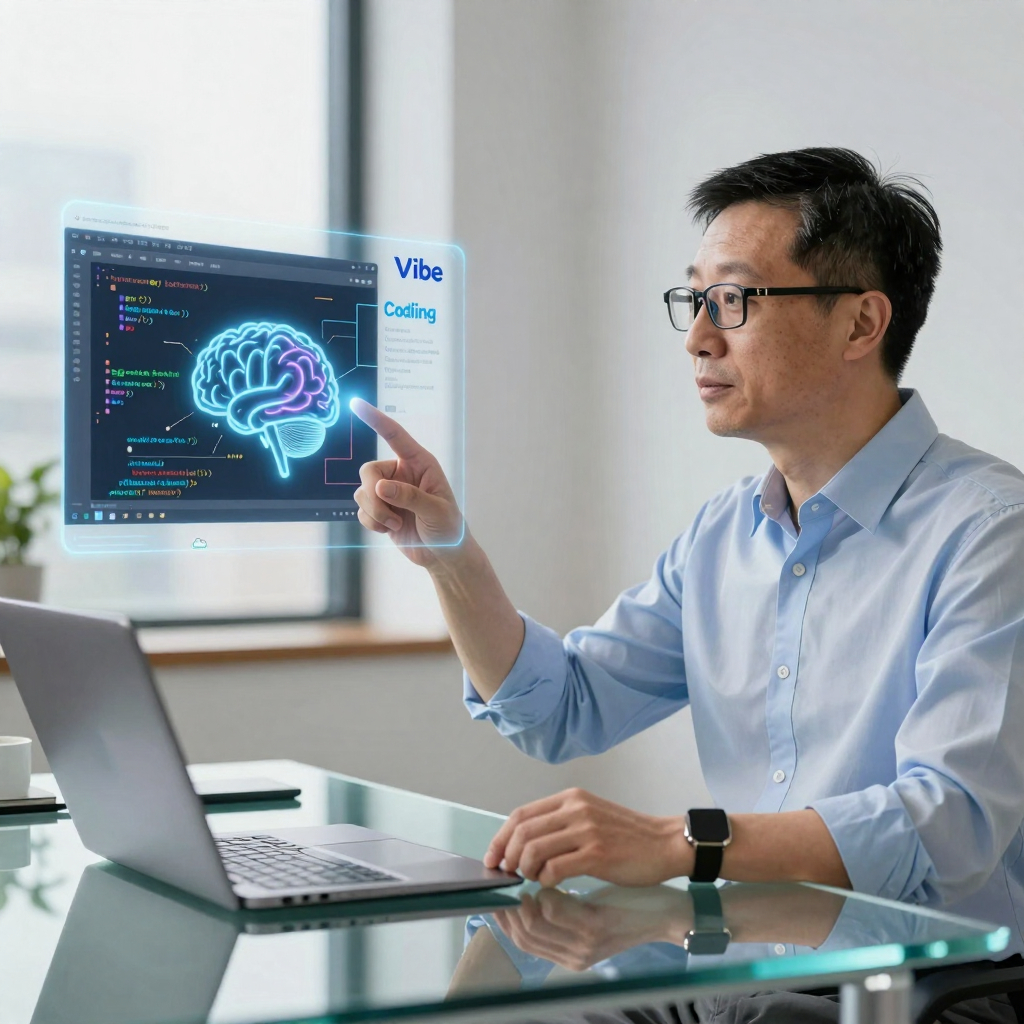
Vibe Coding: AI-First Software Development Changing the Coding Game
Imagine writing code that anticipates your next line before you even think of it. With Vibe Coding, AI-first development turns that vision into reality, letting intelligent assistants suggest functions, catch bugs, and optimize performance in real time. Developers watch as the IDE becomes a collaborative partner, instantly generating boilerplate, refactoring legacy modules, and even drafting documentation. The result is a seamless flow where creativity reigns and repetitive tasks disappear.
In this fast-moving landscape, Vibe Coding stands out as the catalyst for a new era of software creation. It blends cutting-edge machine learning models with developer tools to deliver suggestions that feel intuitive and precise, slashing development cycles by up to 50 %.
Ready to see how AI-first development reshapes every stage of the coding journey? In the next section we’ll dive into the core features that make Vibe Coding a game-changer for teams of all sizes. From ideation to deployment, the platform empowers engineers to focus on innovation while the AI handles the grunt work.
How Vibe Coding Reinvents Development
Vibe Coding places artificial intelligence at the core of the coding process, allowing developers to focus on creativity while the platform handles repetitive tasks. The system leverages state-of-the-art large language models, a cloud-native micro-service architecture, and continuous integration pipelines that are fully AI-aware.
Technology stack
- LLM engine: GPT-4-turbo tuned on millions of open-source repositories.
- Container runtime: Docker + Kubernetes for scalable execution of generated code.
- Version control: Git-Ops workflow with automated pull-request creation.
- Testing suite: AI-driven unit-test generation and coverage analysis.
- Deployment: Serverless functions on AWS Lambda, Azure Functions, or Google Cloud Run.
Workflow
- Prompt – The developer describes a feature or bug in natural language.
- Generate – Vibe Coding’s LLM produces code, tests, and documentation instantly.
- Validate – Automated AI reviewers run static analysis and suggest refinements.
- Commit – The platform opens a pull request, runs CI/CD pipelines, and merges upon approval.
- Monitor – Real-time telemetry alerts developers to performance regressions.
Why Vibe Coding Leads the AI-First Movement
Because it treats AI not as an add-on but as the primary engine of software creation, Vibe Coding delivers speed, quality, and cost savings that traditional toolchains cannot match.
Key differentiators
- End-to-end automation – From design sketches to production deployment, every step is AI-powered.
- Context-aware coding – The platform remembers project architecture, coding standards, and business rules, reducing mismatches.
- Self-healing code – When runtime errors appear, Vibe Coding suggests patches and auto-applies fixes.
- Human-centric control – Developers retain final approval, ensuring trust and accountability.
- Scalable collaboration – Teams can share AI-generated components across repositories, accelerating knowledge transfer.
By integrating these capabilities, Vibe Coding reshapes the development lifecycle, turning AI into a true co-author that drives innovation at unprecedented pace.
| Feature | Vibe Coding | Traditional Coding | Competitor X |
|---|---|---|---|
| Code Generation Speed | Generates code in seconds, drastically faster than manual typing. | Relies on human speed; can be slow for large projects. | Produces code quickly but may need more post-editing. |
| Error Reduction | AI suggestions cut syntax errors by up to 70%. | Human errors are common, especially in complex logic. | Error reduction similar to Vibe, but varies by model. |
| Learning Curve | Minimal; developers start coding instantly. | Steep; requires mastering language and tooling. | Moderate; users must learn platform-specific prompts. |
| Integration Flexibility | Plug-and-play APIs for most IDEs and CI pipelines. | Requires custom scripts and manual setup. | Supports major IDEs but limited CI integration. |
| Cost Efficiency | Subscription model saves hours, lowering labor cost. | High labor cost due to longer development cycles. | Comparable pricing, but extra fees for premium models. |
Benefits of Using Vibe Coding in Modern Projects
Vibe Coding transforms how developers build software, delivering measurable advantages across speed, quality, and cost.
- Accelerated development cycles – AI-driven suggestions cut routine coding time by up to 40 %.
- Higher code quality – Real-time linting and pattern recognition reduce bugs before they ship.
- Seamless language agnosticism – Switch between Python, JavaScript, Go, or Rust without rewriting boilerplate.
- Scalable collaboration – Shared AI assistants keep distributed teams aligned on standards.
- Cost efficiency – Fewer developer hours translate into measurable savings for startups and enterprises alike.
Real-World Application Scenarios
Rapid Prototyping
Startups can spin up functional MVPs in days rather than weeks. Vibe Coding generates scaffold code, UI components, and API endpoints from a single natural-language prompt, letting founders focus on product-market fit instead of manual wiring.
Enterprise-Scale Automation
Large organizations automate repetitive maintenance tasks such as log parsing, data-pipeline orchestration, and security policy enforcement. The AI engine learns internal conventions and produces compliant scripts that integrate with existing CI/CD pipelines, dramatically reducing operational overhead.
Educational Tools
Learning platforms embed Vibe Coding to provide instant code feedback, adaptive hints, and auto-graded assignments. Students receive personalized explanations that evolve with their skill level, turning the classroom into an interactive, AI-guided lab.
By leveraging these benefits, teams can stay ahead of competition and innovate faster than ever before.
CONCLUSION
Vibe Coding has reshaped software development by placing artificial intelligence at the core of every coding task. Its AI-first platform accelerates delivery, cuts errors, and empowers teams to focus on creative problem-solving rather than repetitive syntax. By automating code generation, testing, and optimization, Vibe Coding drives faster time-to-market, reduces costs, and raises overall code quality across industries. The platform’s adaptive learning models continuously improve, ensuring that developers benefit from the latest best practices without manual updates. As businesses increasingly demand scalable, secure, and intelligent solutions, Vibe Coding stands out as the catalyst that turns ambitious ideas into production-ready applications.
Based in Hong Kong, SSL Labs brings this vision to life with a strong AI focus and a portfolio that includes custom AI application development, machine-learning pipelines, NLP and computer-vision tools, predictive analytics, and automation services. The company champions ethical AI, prioritizing transparency, bias mitigation, and privacy compliance in every deployment. Leveraging its expertise, SSL Labs integrates Vibe Coding’s capabilities into client projects, delivering smarter, faster, and more responsible software solutions that keep enterprises ahead of the technological curve.
Frequently Asked Questions (FAQs)
Q1: What is Vibe Coding and how does it differ from traditional coding?
Vibe Coding is an AI-first development platform that writes, tests, and optimizes code automatically. Unlike conventional coding, it leverages large language models to accelerate delivery, reduce errors, and adapt to changing requirements in real time.
Q2: Can Vibe Coding integrate with existing development tools?
Yes, Vibe Coding offers seamless plugins for Git, CI/CD pipelines, and popular IDEs, allowing teams to adopt AI assistance without disrupting their current workflow.
Q3: How does Vibe Coding ensure code quality and security?
The platform runs continuous static analysis, automated unit tests, and security scans on every generated snippet, guaranteeing compliance with industry standards before deployment.
Q4: Is Vibe Coding suitable for both startups and enterprise projects?
Absolutely; its scalable architecture supports small prototypes as well as large-scale applications, giving organizations of any size a cost-effective path to AI-enhanced development.
Q5: What kind of support and training does Vibe Coding provide?
Users receive onboarding tutorials, 24/7 technical support, and a knowledge hub with best-practice guides, ensuring teams can quickly master AI-driven coding.